

Foreign Worker Compliance Platform
From Employer Demand to Deployment, With the Evidence to Prove It
Recruitment, records and compliance follow-up, connected. Starting in Malaysia.


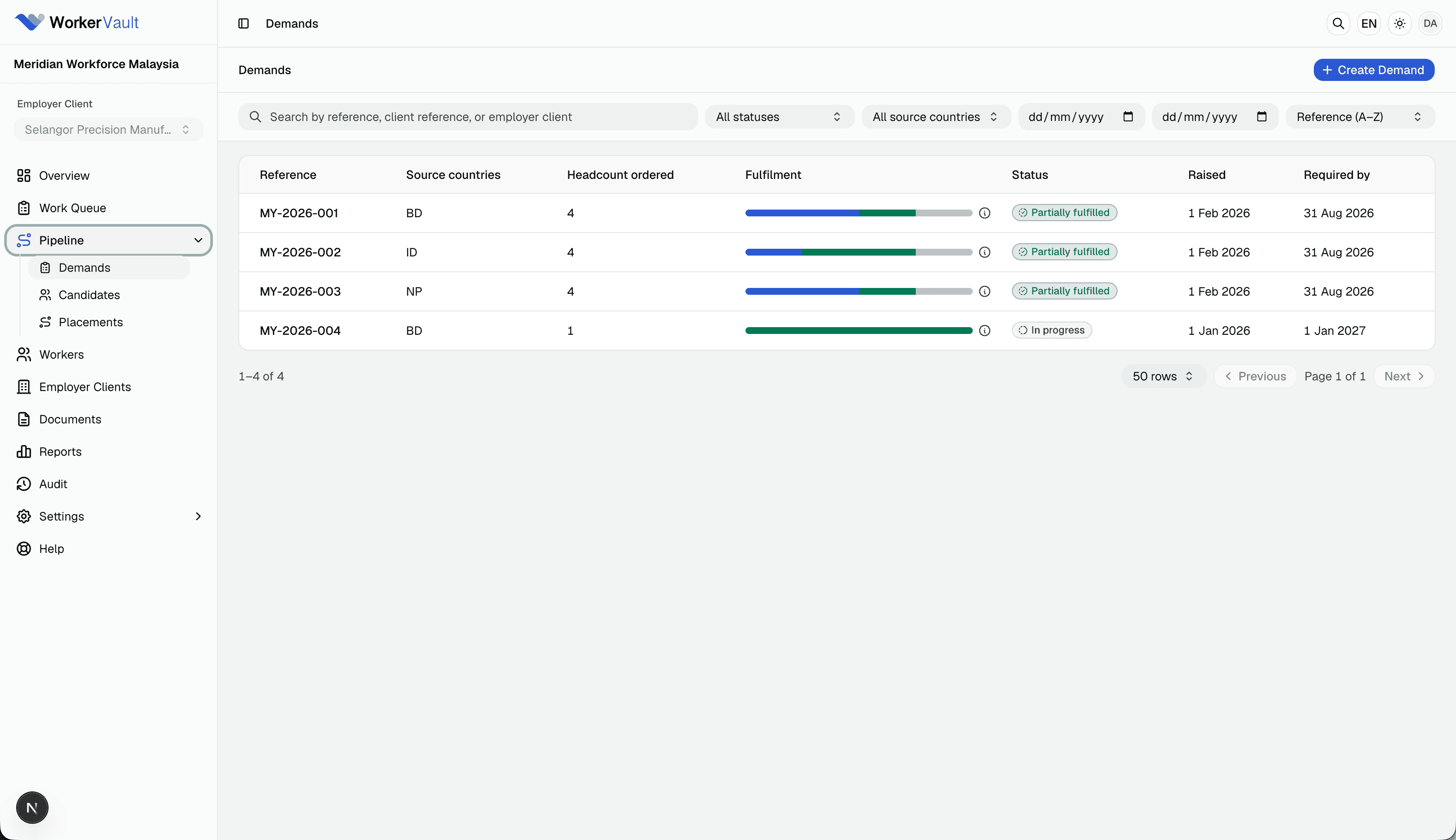
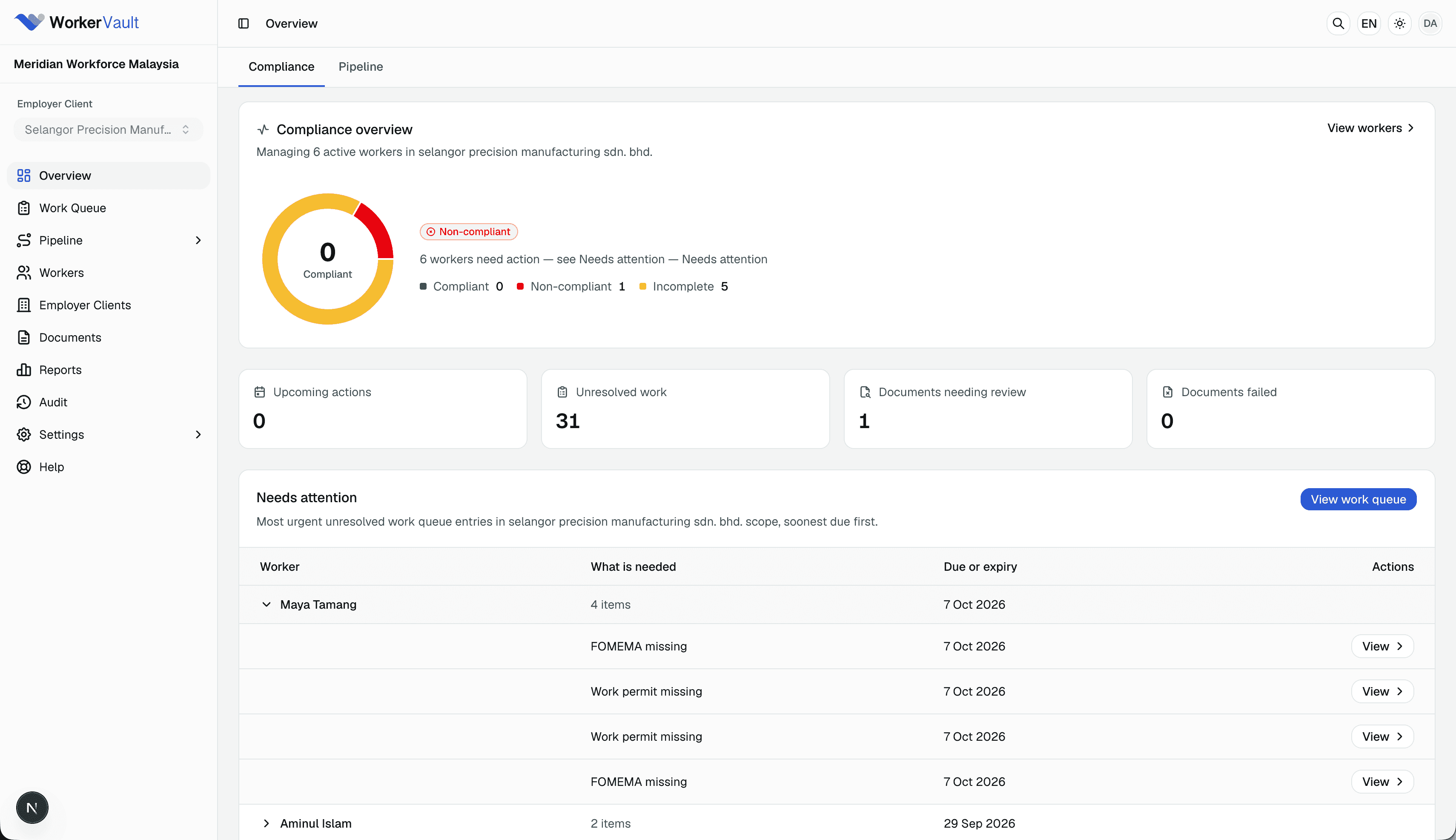
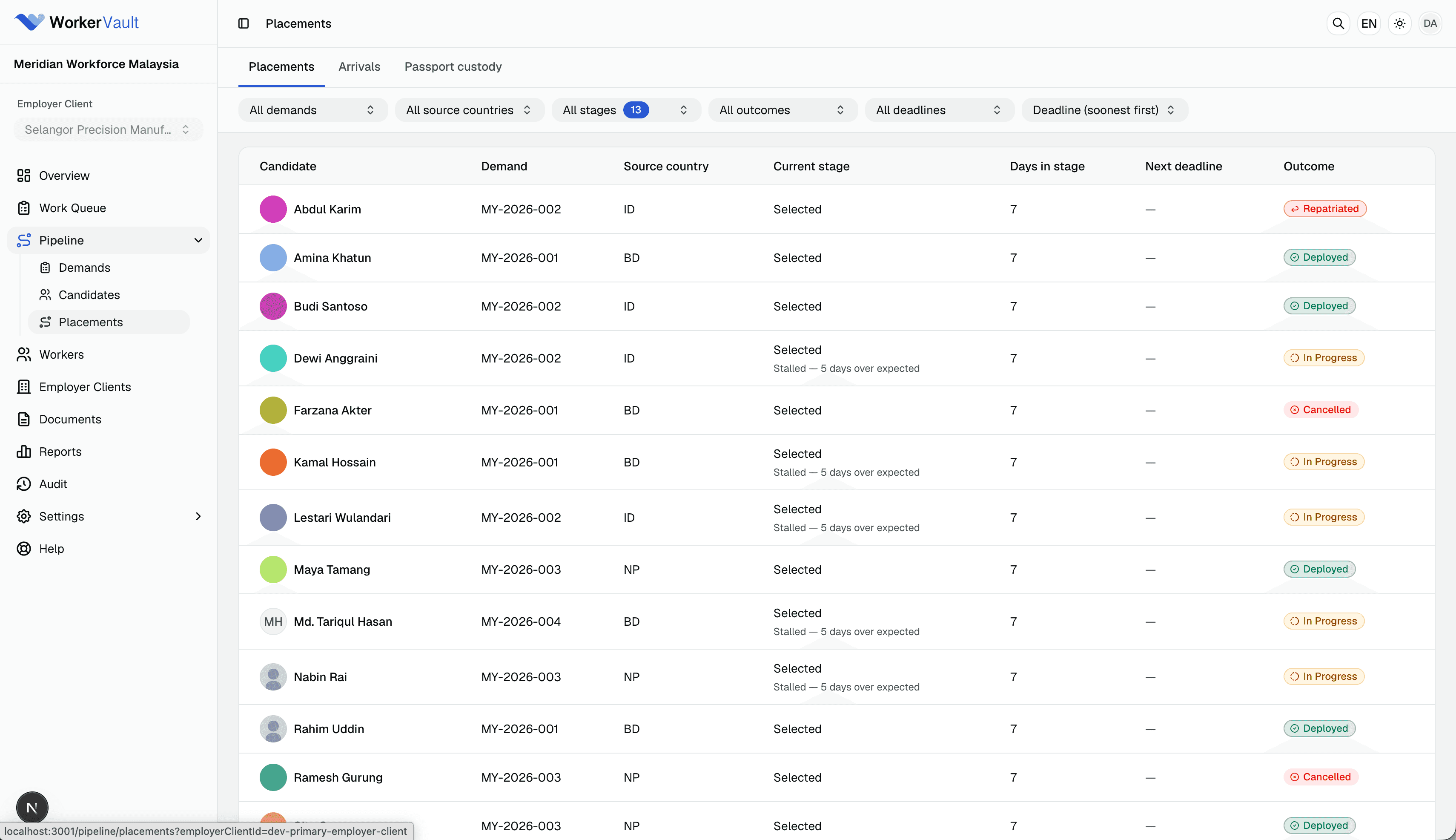
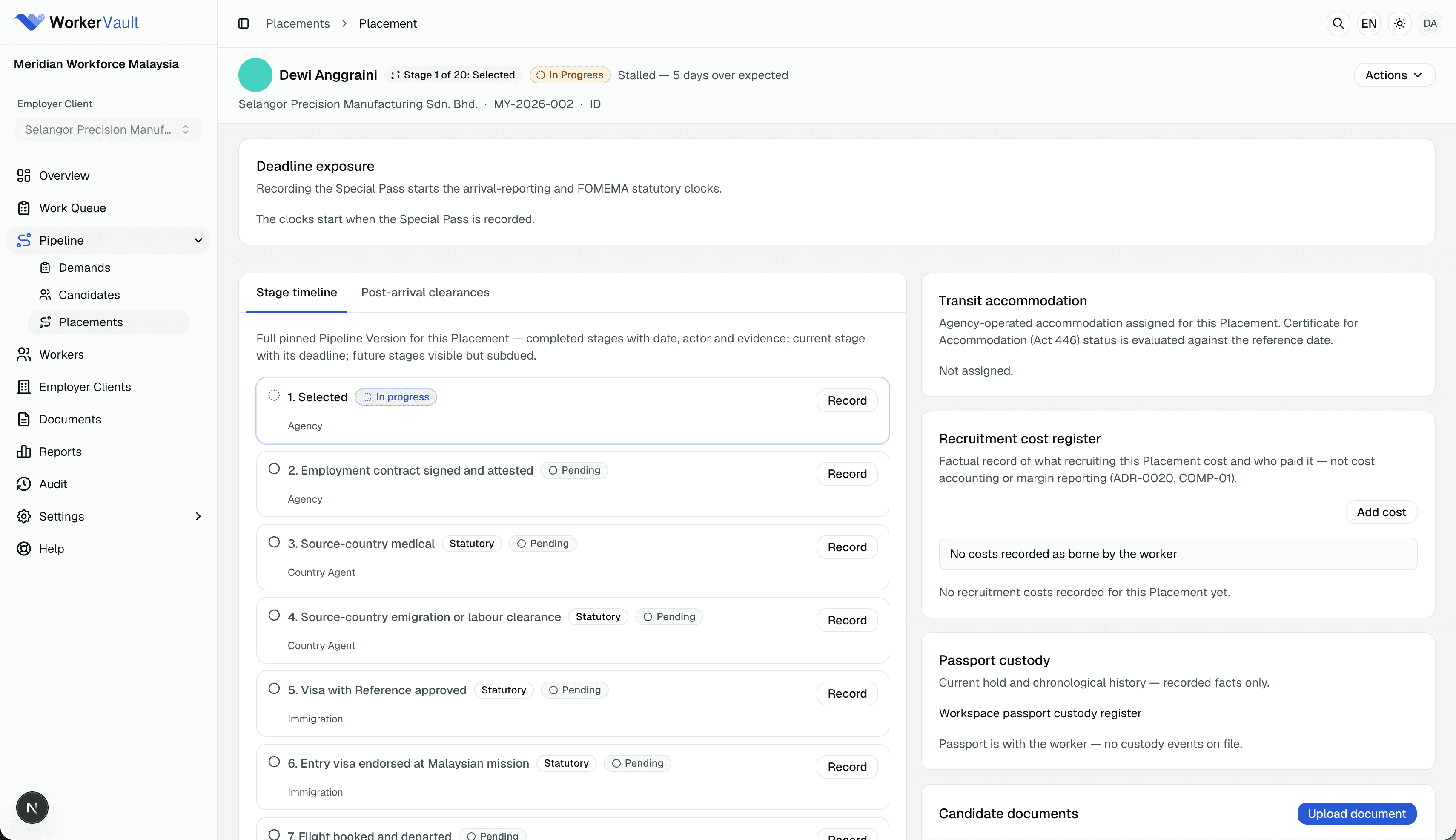
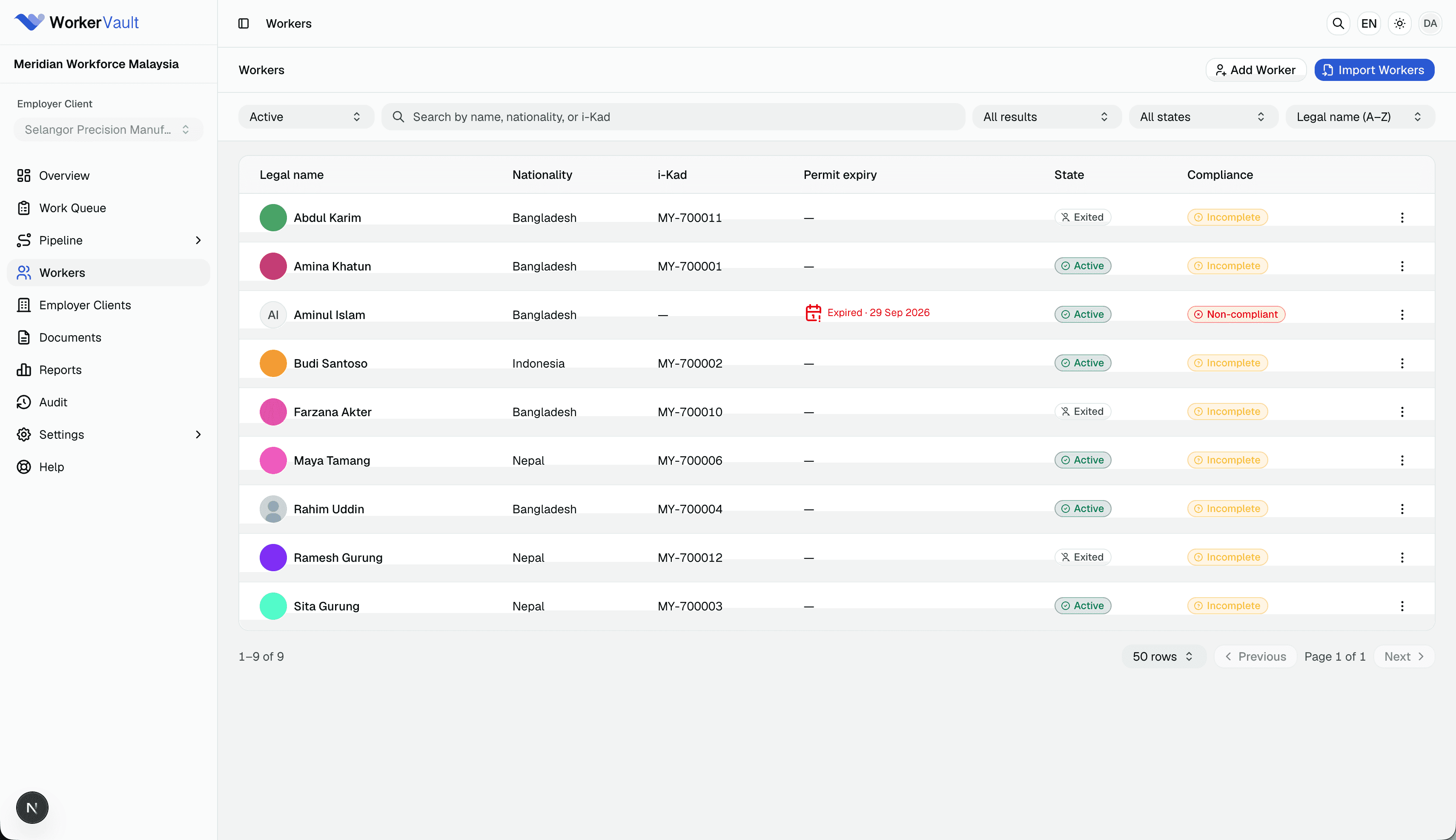
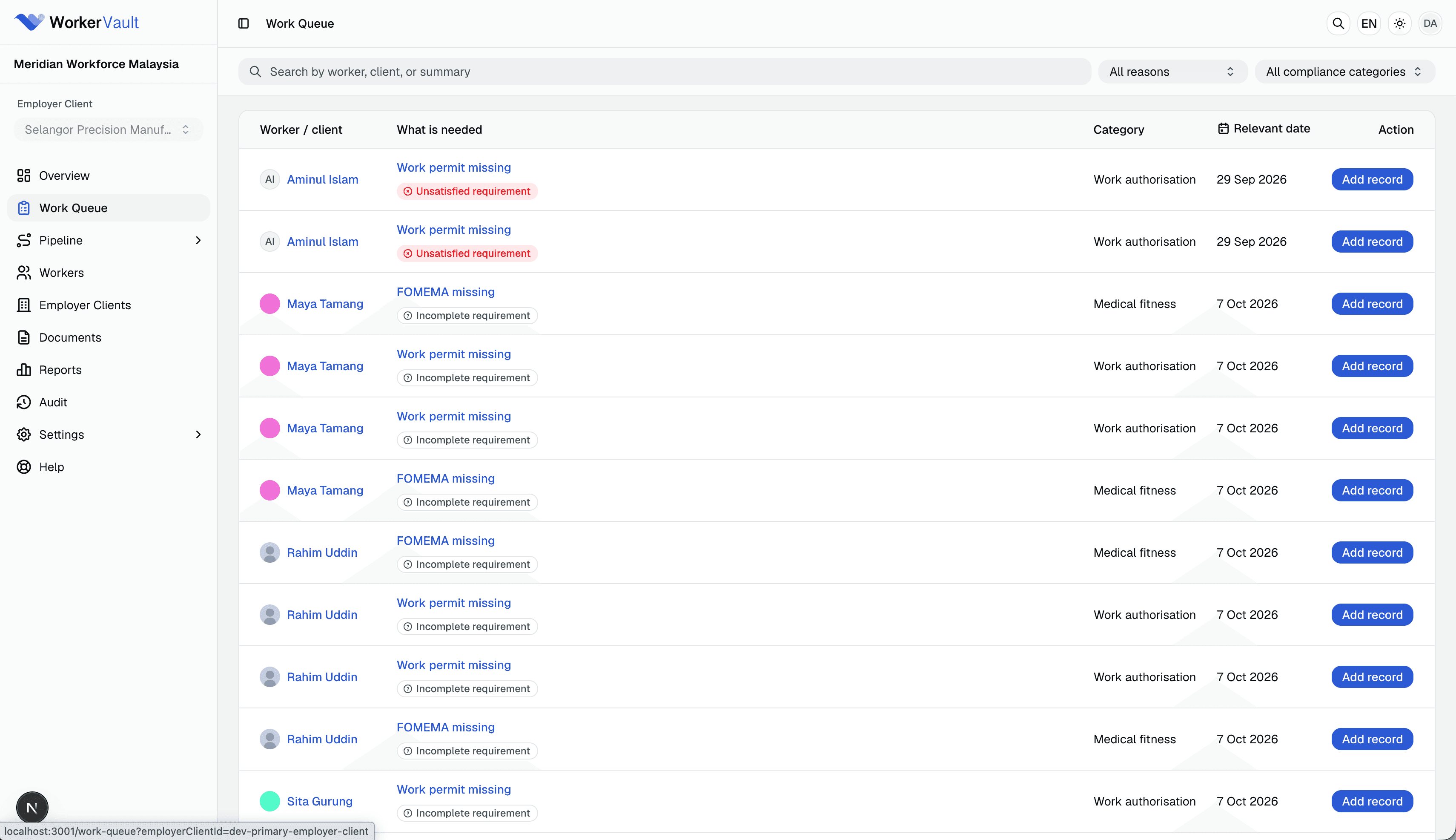
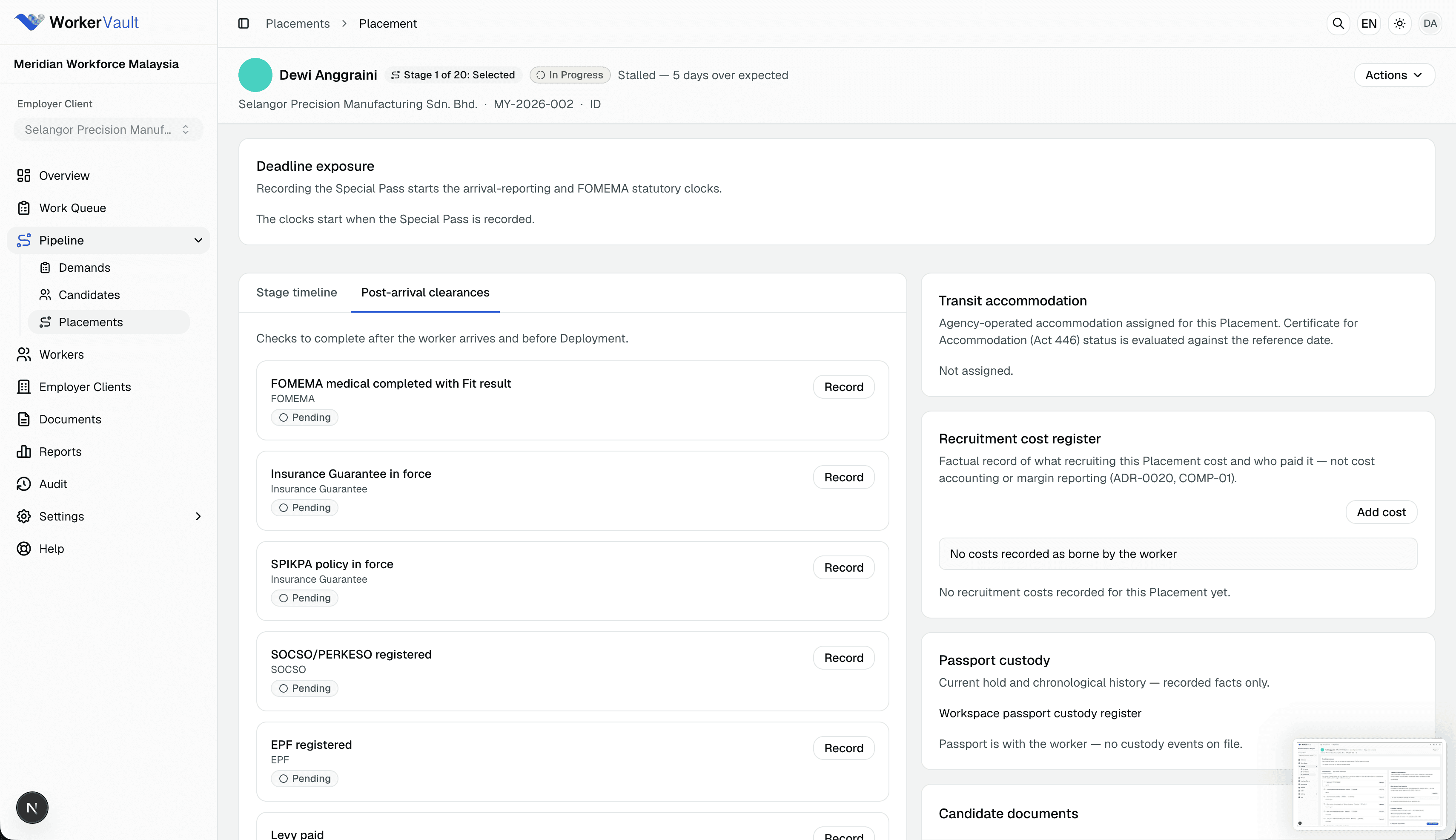
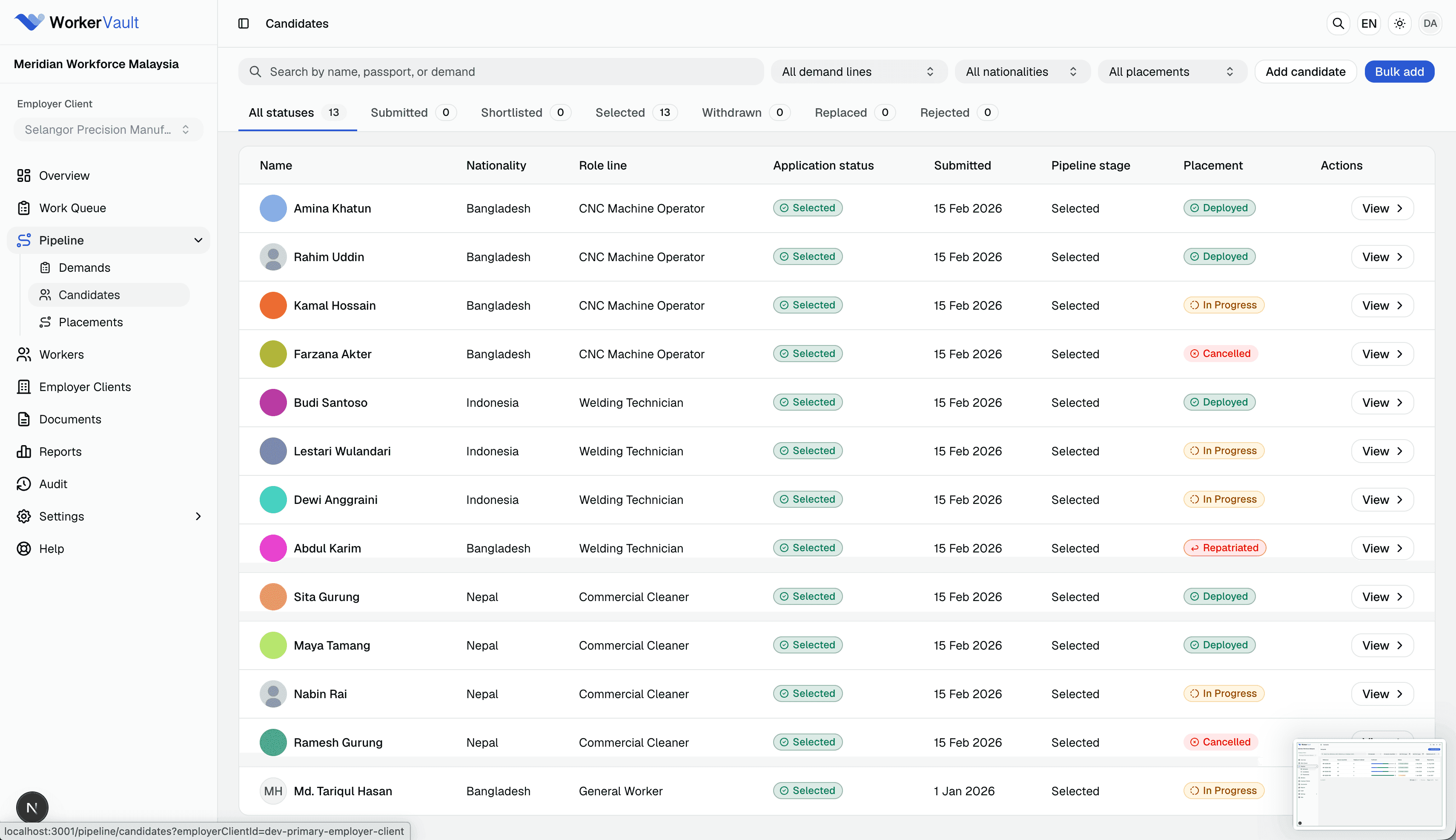
Placing a foreign worker is not one transaction. It is a chain of dependent steps across employers, source-country agents, medical screening, permits, insurance, levies, and registrations, and each step has its own date, document, and deadline. In Malaysia, a Special Pass starts the clock on the arrival report and the FOMEMA medical. Miss a clock, or lose the document that proves a step was done, and the cost lands on the agency and the employer.
Recruitment agencies were managing this across spreadsheets, message threads, and folders, with no single place that connected a worker's evidence to what the agency owed an employer client. Employers wanted visibility without access to everything. Agencies needed to know what was overdue before an authority or a client told them.
The goal was a platform that follows a placement from the first employer order to deployment, keeps every document and date with the worker, and tells the team what needs attention and why. It also had to respect a hard boundary: the agency stays responsible for filings and legal decisions, so the software records, tracks, and flags. It does not file, approve, or advise.


Our Approach
At Cygnis, we tackled this project with a user-centric, compliance-first methodology:

Discovery & Research
We mapped the placement process end to end, from employer demand through clearances to deployment, and identified which steps are statutory, which carry deadlines, and which records an agency must be able to produce. We separated what the platform should decide from what it should only surface, and what it should never do, such as filing with authorities or holding government portal credentials. That set the product's scope and its boundaries.

Design Thinking
We defined who touches a worker record and what each of them should see: owners and admins across all employer clients, managers, clerks limited to their assigned clients, employer contacts with read-only access, and source-country agents held as reference records with no login. Role boundaries were designed first, then the screens. We prototyped the pipeline and Work Queue around one question: what does this person need to do next, and why?

Agile Development
We built in iterative releases, starting with the placement pipeline and worker record as the core, then layering compliance rules, the Work Queue, client workspaces, and reporting on top of the same records. Architecture decisions were written down as they were made, and the database, background jobs, and access rules were tested as part of the build rather than added at the end. Onboarding is assisted, so early agencies shape the product directly.

Technology Stack
Next.js and React with TypeScript for the web application, running on Bun. PostgreSQL 18 as the system of record, accessed through Drizzle, with row-level security enforcing tenant and role boundaries in the database itself. Better Auth for identity and sessions. Zod for validation. Private S3-compatible object storage for documents, a PostgreSQL-backed job queue with a separate background worker for compliance recalculation, document previews, report exports, and email digests, and next-intl for English and Bahasa Melayu. Delivered as containers, with automated deployment through GitHub Actions.
Solution
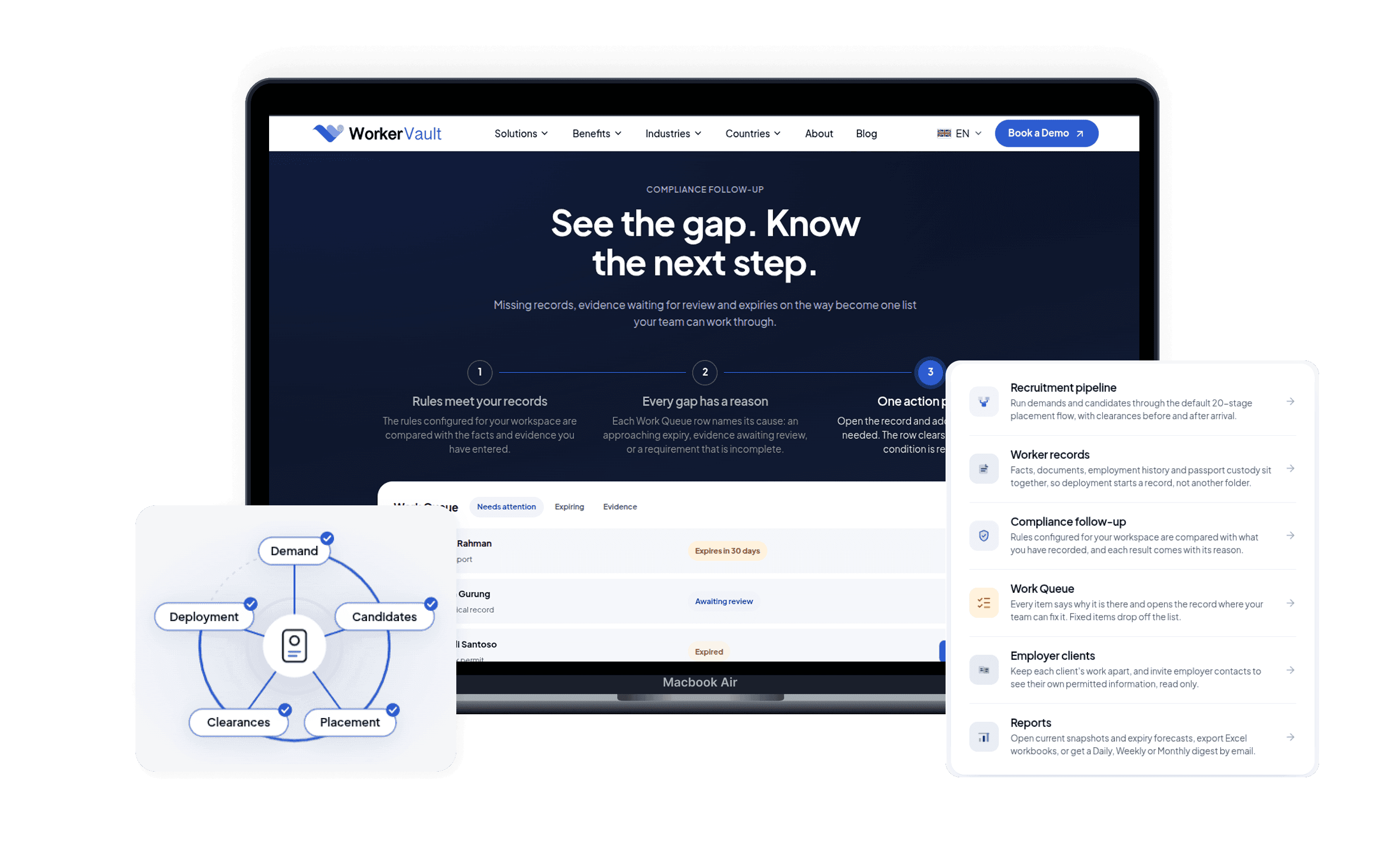
Cygnis built Worker Vault to connect every recruitment placement from employer demand to deployment. It unifies worker records, document management, compliance tracking, and employer visibility in one secure workspace.
Recruitment Pipeline
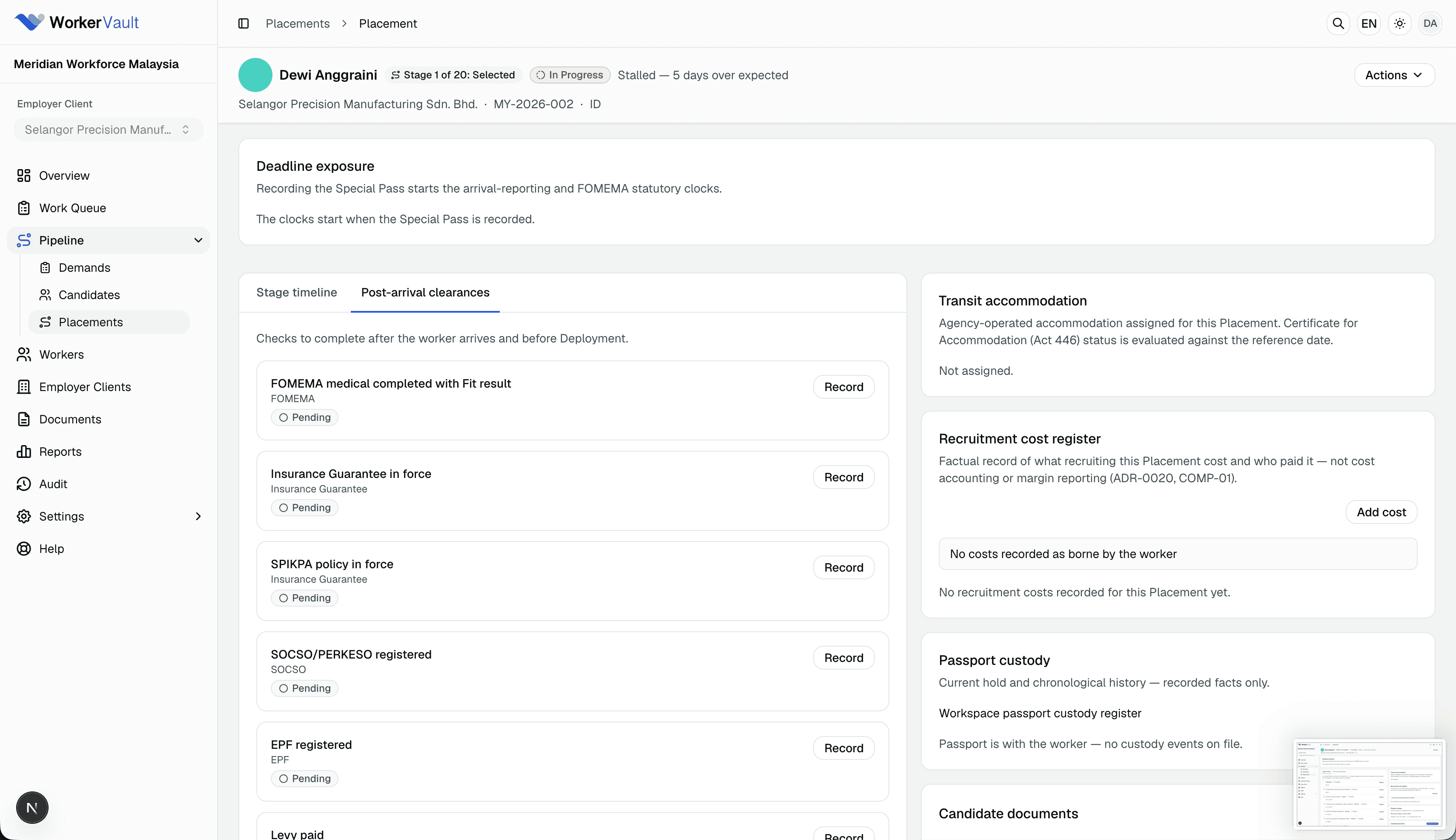
Employer demand is recorded as reference-coded demand lines with headcount, candidates are shortlisted against them, and each placement moves through a default 20-stage flow, with statutory stages marked on the Malaysia setup. Post-arrival clearances (FOMEMA, Insurance Guarantee, SPIKPA, SOCSO/PERKESO, EPF, levy) are tracked on the placement, along with transit accommodation and passport custody. Deadlines such as the arrival report due 14 days after Special Pass are visible before they slip.
Worker Records and Evidence
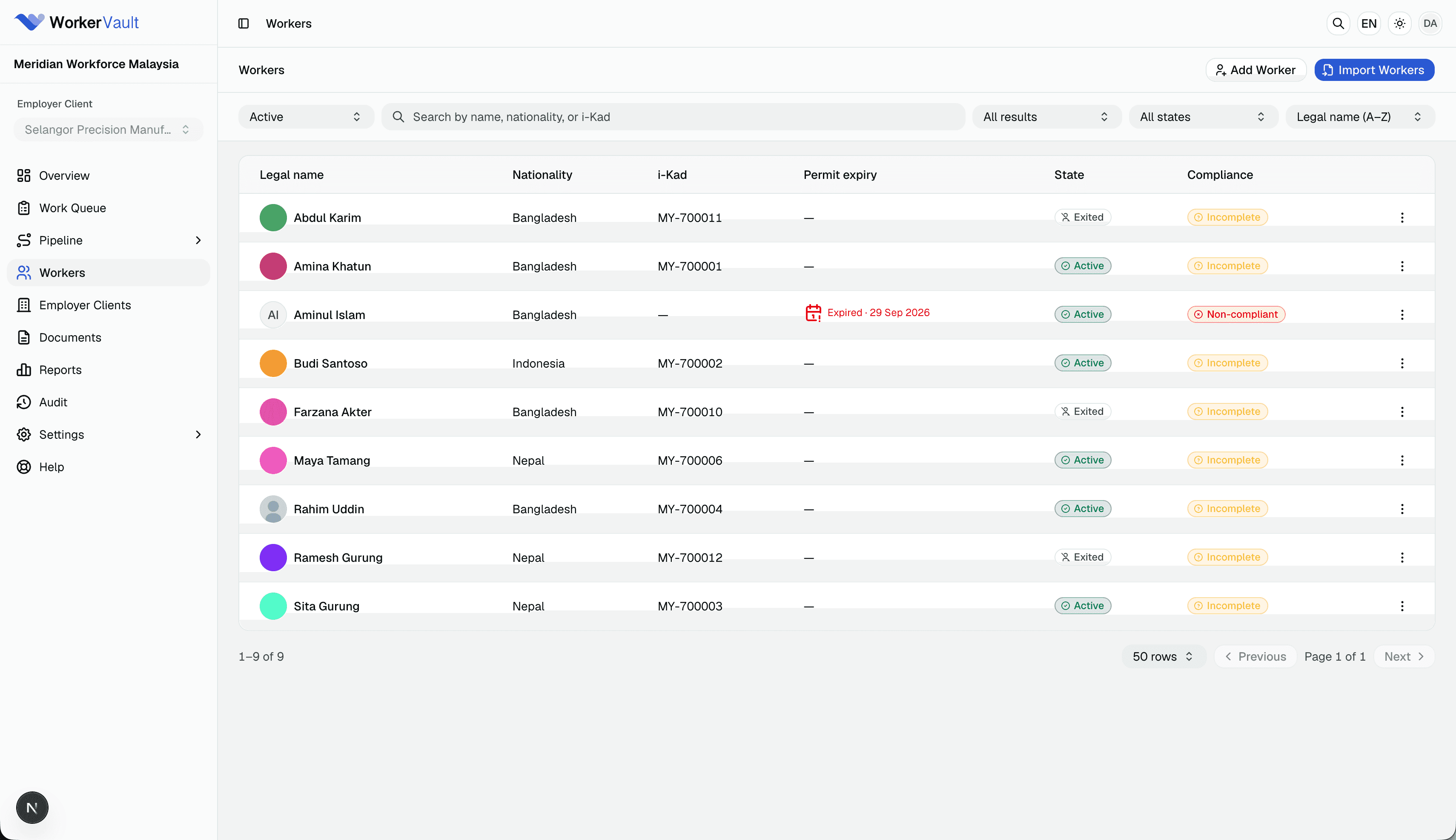
Deployment creates the worker and employment record, carrying over documents, permit dates, and costs from the placement. Passports, work permits, medical records, and contracts are kept with version history, so corrections never erase what came before. Current and previous employment sit on the same record. Existing workers can be brought in from XLSX or CSV through a preview step that flags rows needing review before they become records.
Compliance Follow-up
Rules are maintained as effective-dated decision tables, not hard-coded logic, and are compared with recorded data. Each requirement is assessed as Compliant, Non-compliant, or Incomplete, with the reason attached, and results are recalculated automatically as facts change. Assessments cannot be overridden by hand, so a result always traces back to preserved evidence and the rule version in force. Expiry warnings appear while records are still valid, so the team acts before a permit lapses rather than after.
Work Queue
One list collects missing records, upcoming expiries, documents awaiting review, and incomplete requirements. Every row names the worker, states why it is there, and links to the record that fixes it. When the source record is corrected, the row clears.
Employer Client Workspaces
One agency workspace holds many employer clients, and every view follows the selected client. Clerks see only the clients assigned to them. Employer contacts are invited into a read-only view limited to their own workers, placement progress, and reports. Other clients and agency settings stay hidden, and access limits are enforced in the database, not only in the interface. Every full-size document view and download is recorded in an audit trail.
Reports and Secure Sharing
Compliance snapshot, expiry forecast (up to 12 months), and demand fulfilment reports show where each client stands. Reports export to Excel and can be sent to the team or client as daily, weekly, or monthly digests. Download links expire after 24 hours and require identity confirmation, keeping sensitive worker and compliance information protected during sharing, keeping sensitive worker and compliance information protected during sharing.
 Browse more case studies


